Infrastructure and Environmental Systems (INES)
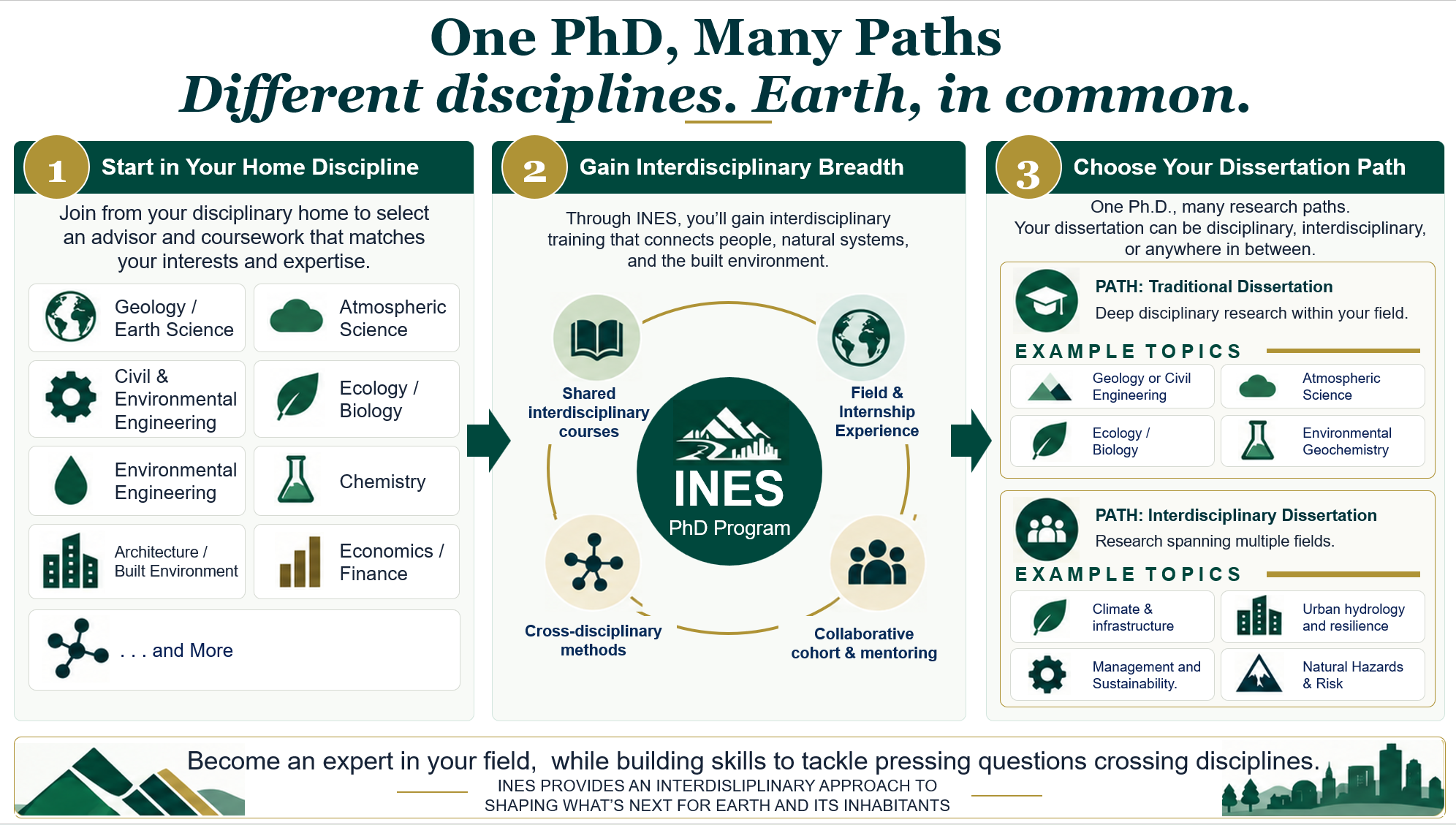
Build deep expertise in your field — with the added advantage of interdisciplinary training.
The INES Ph.D. supports dissertation research in traditional disciplines such as geology, atmospheric science, hydrology, environmental engineering, ecology, chemistry, and more, while giving every student broader training at the intersection of Earth, environment, and infrastructure. INES engages a wide range of faculty expertise originating from academic programs in civil and environmental engineering Department, Earth, Environmental and Geographical Sciences Department, Industrial and Systems Engineering Department, School of Energy and Architecture; as well as associated disciplines of economics and finance, ecology, biology and chemistry. Whether your research stays within one discipline or spans several, INES gives you the faculty, methods, and perspective to pursue the questions that matter most.
All of our full-time students receive some form of financial support, tuition awards, and health benefits. Our curriculum has been updated to reflect the program’s interdisciplinary STEM-approach in teaching and research activities.
Several national and international universities collaborate with INES on faculty and student exchanges, and joint supervision of doctoral students. We invite your exploration of this truly interdisciplinary educational opportunity.
To learn more, reach out. We look forward to hearing from you!
Jy S. Wu, Ph.D., P.E., P.H.
Department of Civil and Environmental Engineering
Director of INES
jwu@charlotte.edu
Missy Eppes, Ph.D.
Department of Earth, Environmental and Geographical Sciences
Associate Director of INES
meppes@charlotte.edu
Shen-En Chen, Ph.D., P.E.,Department of Civil and Environmental Engineering
Recruitment Advisor
Jessica Waldman
Academic Advisor